




Blog
The Real Benefits of Microdosing: What People Feel, and What the Research Actually Shows
Microdosing used to be a fringe word you heard in a Silicon Valley podcast. Not anymore. In a nationally representative US survey, about 5.3% of adults said they had tried microdosing psilocybin, and roughly 47% of people who had used psilocybin in the past year said they were microdosing the last time they took it (RAND, 2025). That is not a trend. That is a habit a lot of regular people have quietly built into their week.
Here is the thing almost nobody microdoses for fun. They do it for a reason. They want the morning dread to ease up. They want to read a page without it sliding off their brain. They want to feel something other than flat. So this guide is built around those reasons, the actual pain points people type into a search bar, and what the research says about each one.
We sell these capsules, so we will be straight with you. Some of these benefits have real, repeated evidence behind them. Some of them are mostly what people report, with the science still catching up. We will tell you which is which. That is the only honest way to write this.
Key takeaways
- Microdosing is mainstream now. About 5.3% of US adults have tried it, and close to half of recent psilocybin users were microdosing (RAND, 2025).
- Survey research consistently links microdosing to lower stress, anxiety and depression, plus better mood and focus (Rootman et al., 2021).
- The best controlled trials tell a humbler story. The largest placebo-controlled study found microdoses improved wellbeing about as much as a sugar pill (Szigeti et al., 2021).
- Expectation does real work here. That does not make the experience fake, but it does mean the science is not settled, and we will not pretend it is.
What does microdosing actually mean?
A microdose is a small amount of psilocybin, usually a tenth to a twentieth of a recreational dose, taken on a schedule rather than for a trip. You are not meant to feel high. You are meant to feel like a slightly better version of your normal self, or to feel nothing obvious and notice the difference later in the week.
Most people land somewhere between 75mg and 300mg of dried mushroom per dose, then follow a rhythm like one day on, two days off. Our own range maps to that spread, from Clarity Lite at 75mg for first-timers up to Wavy at 300mg for people who want more. The point is consistency and a low dose, not intensity.
Can microdosing help with anxiety and chronic stress?
This is the number one reason people come looking. In a study of more than 4,000 people, those who microdosed reported lower levels of anxiety, depression and stress than people who did not, and the gap was clearest among people who already had mental health concerns (Rootman et al., Scientific Reports, 2021). A follow-up tracking nearly a thousand microdosers over a month found the same pattern held across genders.
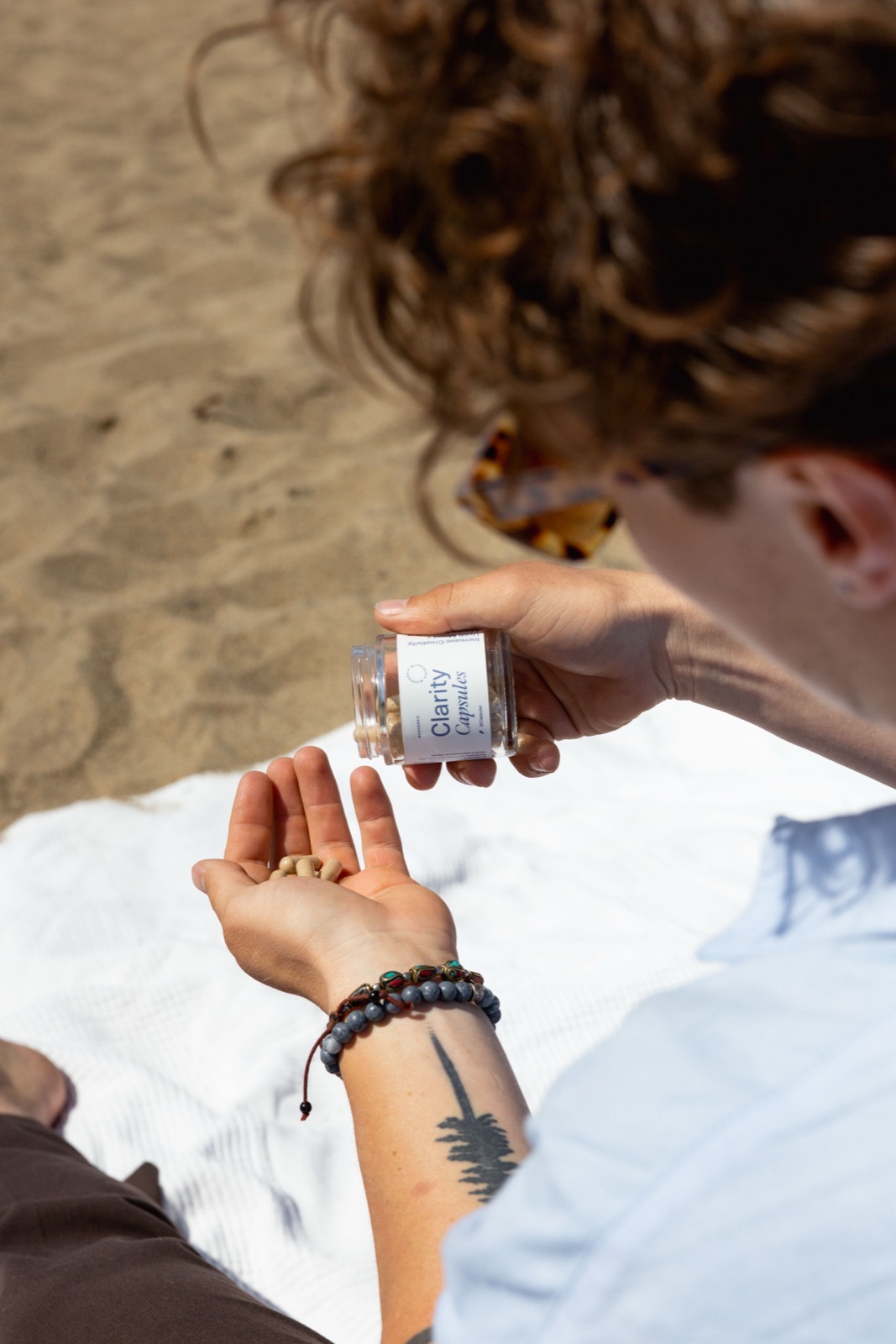
Here is the honest counterweight. When researchers ran a proper placebo-controlled version of this question, anxiety dropped in the people taking real microdoses and in the people taking blanks, with no meaningful difference between them (Szigeti et al., eLife, 2021). So is it the mushroom, or is it the ritual of taking something and paying attention to how you feel? The truth is probably some of both.
What we can say plainly is that a lot of people who feel wound up describe microdosing as taking the edge off without flattening them out. If chronic stress is your starting point, our piece on burnout and modern life is worth reading alongside this one.
Does microdosing improve mood?
Mood is the single most reported benefit. In a qualitative study of 278 microdosers, “improved mood” was the most common thing people brought up, named by about 27% of respondents (Anderson et al., Harm Reduction Journal, 2019). Separate work tracking people over six weeks found self-reported depression and stress scores fell over that window (Polito and Stevenson, PLOS ONE, 2019).
According to that 2019 codebook, improved mood was cited by roughly 27% of microdosers and improved focus by about 15%, making mood the most frequently reported effect in the sample (Anderson et al., 2019). These are people describing their own experience, not a controlled trial, which is exactly why we are showing you the source and the method, not just the number.
One nuance worth knowing for women microdosing alongside a cycle is not one-size-fits-all. We dug into how it interacts with hormones in our guide to microdosing and your menstrual cycle.
Does microdosing actually sharpen focus and clear brain fog?
This is where survey reports and lab trials disagree the most, so pay attention. People love telling you microdosing helps them focus. About 15% of microdosers spontaneously named sharper focus as a benefit (Anderson et al., 2019). But a 2025 meta-analysis pooling 14 controlled studies and over 1,600 participants found no reliable cognitive boost from microdosing, and the only consistent effect was a small dip in cognitive control (Neuroscience and Biobehavioral Reviews, 2025).
So which is true? Probably both, in different senses. People genuinely feel more focused, and that feeling is real to them, but when you blind the test so nobody knows if they took the active dose, the measurable edge mostly disappears. If your goal is real cognitive support, the more evidence-backed move is stacking psilocybin with something like lion’s mane, which we cover in The Neuroplasticity Stack. Our Clarity Capsules at 125mg are the formula most people reach for when focus is the goal.
What about creativity?
The creativity story is the classic split, and it is a good test of whether a source is being honest with you. A 2019 survey found current and former microdosers scored higher on a creativity task and on open-mindedness than non-microdosers (Anderson et al., Psychopharmacology, 2019). Sounds great. Then the controlled trials arrived.
A double-blind study gave people a single 0.5g psilocybin microdose or a placebo and measured 25 different outcomes, including creativity. The microdose beat placebo on none of them, and the only thing that predicted a stronger effect was whether people correctly guessed they had taken the real thing (Cavanna, de Wit et al., Translational Psychiatry, 2022). Three further double-blind trials in 2025 reached the same verdict on creativity. The survey says yes, the controlled trials say placebo, and a good brand tells you both.
Energy, motivation, and getting unstuck
Energy is the thinnest part of the evidence, so we will keep our claims small. Across retrospective surveys, somewhere between 11% and 45% of microdosers reported more energy, while around 8% to 10% reported less (summarized in Neuroscience and Biobehavioral Reviews, 2025). That is a wide spread with a real minority going the other way, which tells you energy effects are not uniform and have no controlled trial behind them yet.

What people describe more reliably than raw energy is motivation, the feeling of caring about the thing again instead of doom-scrolling past it. That is harder to measure and easy to confuse with simply having decided to take better care of yourself. If you want a bigger, more present dose for active days, Macro Capsules at 450mg sit at the top of our range. Treat any energy benefit as a maybe, not a promise.
Microdosing versus antidepressants: the emotional blunting question
A lot of people arrive here from a specific frustration. Their SSRI lifted the floor but stole the ceiling, and they feel emotionally numb. Emotional blunting is reported by close to half of people on these medications, and it is one of the most common reasons they quit. That frustration is real, and it is fueling a lot of the interest in psychedelics.
Read this part carefully. The strongest evidence on psilocybin and emotional blunting comes from single high therapeutic doses given in supervised therapy, not from microdosing. In a head-to-head trial, full-dose psilocybin matched the antidepressant escitalopram on core depression scores but did better on wellbeing and emotional connection (Carhart-Harris et al., NEJM, 2021). Brain imaging later showed the SSRI dampened emotional response while psilocybin left it largely intact (American Journal of Psychiatry, 2025). Those are big single doses in a clinic, not the small daily doses this article is about. Do not blur the two.
On the microdosing side specifically, one naturalistic study of adults with ADHD found those microdosing showed better emotional expression and lower symptom scores than people on conventional medication, though the empathy advantage faded once a control group was added (European Psychiatry, 2024). It is a hopeful signal, not a green light, and microdosing is not a safe swap for prescribed medication. Talk to your doctor before changing anything.
So does microdosing actually work? An honest read
Here is the fairest summary we can give you. A 2024 systematic review concluded that the growing body of observational evidence links microdosing to better mental wellbeing, but causation is unproven because of small samples, few controlled studies, and powerful expectation effects (Journal of Clinical Psychiatry, 2024). Translated the people who microdose report feeling better, and the science cannot yet say for certain how much of that is the molecule.
Does that make microdosing pointless? We do not think so. A placebo effect is not a fake effect. If a small daily ritual helps you feel calmer and show up better, the improvement you feel is genuine improvement to your life, whatever the mechanism turns out to be. What it means is that you should go in with clear eyes, modest expectations, and the understanding that you are part of a story the research is still writing. That posture, more than any single capsule, is how we think about this whole category.
How to think about starting
If you decide to try it, start low and stay consistent rather than chasing a feeling. Most people begin around 75mg to 125mg and run a simple schedule like one day on, two days off, then judge by how the week went, not the hour. We are not giving medical advice here, and psilocybin is a controlled substance in many places, so know your local rules before you order.
For first-timers, Clarity Lite at 75mg is the gentle entry point. Clarity at 125mg is the everyday favorite for calm and focus. Wavy at 300mg and Macro at 450mg are for people who want a fuller dose. Not sure where to start? Take our two-minute quiz and we will point you to the right one.
Frequently asked questions
What are the benefits of microdosing?
The most commonly reported benefits are better mood, lower stress and anxiety, and sharper focus. In one survey of 278 microdosers, improved mood was the top response at about 27% (Anderson et al., 2019). These are self-reported, and controlled trials show expectation plays a large role.
Is microdosing backed by science?
Partly. Observational studies of thousands of people link microdosing to lower depression, anxiety and stress (Rootman et al., 2021), but the largest placebo-controlled trial found microdoses matched placebo on wellbeing (Szigeti et al., 2021). The honest answer is the evidence is promising but unsettled.
How much should I take to microdose?
Most people use 75mg to 300mg of dried mushroom per dose on an every-third-day schedule, starting at the low end. There is no official medical dose, since microdosing is not an approved treatment. Begin small, stay consistent, and judge by the week rather than the hour.
Will microdosing make me feel high?
It should not. A microdose is subtle by design, roughly a tenth of a recreational dose. In controlled studies, many people could not reliably tell whether they had taken an active dose or a placebo (Cavanna and de Wit, 2022), which is the whole point of microdosing.
Can microdosing replace my antidepressant?
No. The studies comparing psilocybin to SSRIs used single high therapeutic doses in supervised therapy, not microdoses (Carhart-Harris et al., 2021). Never stop or change prescribed medication without talking to your doctor first.
The bottom line
Microdosing has gone from fringe to mainstream because a lot of people feel it helps them with the exact things modern life wears down, their mood, their nerves, their focus. The survey evidence backs that experience up. The controlled trials remind us that expectation does a lot of the lifting, and that the science still has work to do.
Our promise is simple. We will put the milligrams on the label and the honest research in your hands, and let you decide. If you want to start, our Clarity Capsules are the easiest first step, and the quiz will match you to a dose in two minutes. For the human side of all this, read Kacia’s story in our interview on living, purpose and microdosing.
Keep reading. What microdosing actually costs in Canada, and how to pick a brand that isn’t lying to you.