




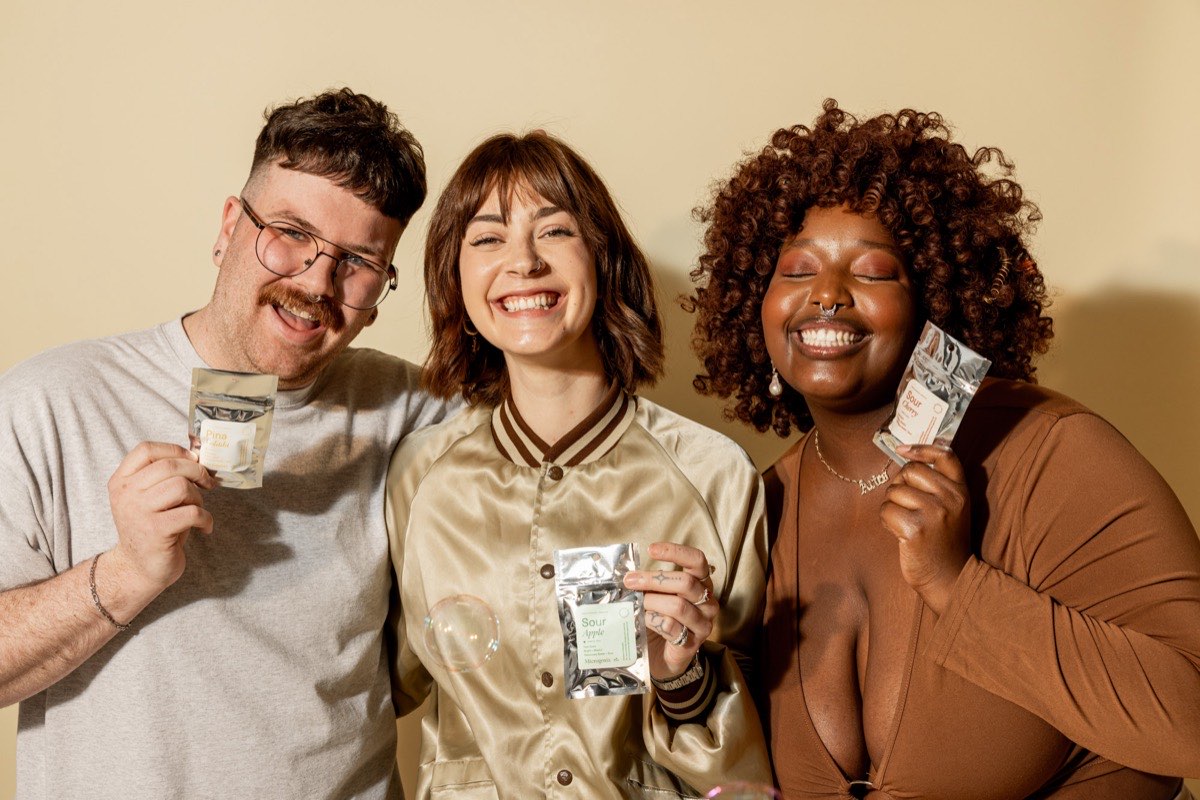
Ask around long enough and the reasons people give for taking mushrooms start to repeat. Not the reasons in the headlines. The ones people actually say out loud when nobody is selling them anything.
Lately 3 of them come up more than the rest. A deeper sense of awareness. Fun. And wanting a night that doesn’t involve a drink.
None of the 3 is about checking out, which is the part most coverage still gets wrong. We sell this stuff, so we’ll be straight with you about which parts have real evidence behind them and which parts are mostly what people report. That’s the only honest way to write this.
The short version
Awareness is the most studied of the 3, and every strong number attached to it comes from a full dose in a clinical setting, not a microdose. Fun is the one nobody puts in a brochure, and there’s better research behind it than you’d guess. Skipping the drink is the one with the most clinical weight, and also the one with the clearest null result sitting next to it. All 3 are worth understanding properly.
1. A deeper awareness
This is the reason with the longest research record, and it’s the one that made psilocybin respectable again.
In 2006 a team at Johns Hopkins gave 36 people a single high dose under supervision and then followed them. Fourteen months later, 67% still ranked that session among the 5 most spiritually significant experiences of their lives. 58% put it among the 5 most personally meaningful. 64% said it had increased their wellbeing or life satisfaction (Griffiths et al., 2008).
Read that again. Not “enjoyed it”. Not “found it interesting”. Top 5, against every other thing that had happened to them, more than a year later.
Then it got stranger. A follow-up analysis looked at personality, specifically Openness, the trait covering curiosity and appetite for the unfamiliar. Openness is supposed to be settled by about age 30 and to drift down roughly 1 point per decade after that. In the volunteers who had a full experience it went up 5.7 points, and it was still more than 4 points above baseline 16 months later. In the people who didn’t have that experience, nothing moved (MacLean, Johnson and Griffiths, 2011).
What is actually happening in there
Here’s the part people get backwards. Psilocybin doesn’t light the brain up. It quiets it down.
Imperial College scanned 30 people and found only decreases in activity, concentrated in the brain’s connector hubs. The size of that quieting predicted how intense the experience felt (Carhart-Harris et al., 2012). A later trial found that after psilocybin the brain’s networks talk to each other more freely, while a standard antidepressant produced no change in network organisation at all (Daws et al., 2022).
Less noise from the hub that narrates your life, more conversation between everything else. That’s the closest thing to a mechanism we have for the word “awareness”.
The honest caveat
Every number above came from 20 to 30mg with a facilitator in the room and most of a day set aside. That is not what a microdose is. Do not let anyone attach those figures to a capsule you take before work, including us.
2. Fun
Fun gets left out of the wellness conversation because it’s hard to dress up as a protocol. People who microdose all week still want a Saturday. That’s not a lapse in seriousness, it’s just true.
It also turns out to be better studied than you’d expect.
Researchers from Yale and the University of Cologne surveyed 1,225 people across 6 multi-day gatherings in the US and the UK. People who had taken a psychedelic reported better mood, and the effect ran through 2 things in particular. A sense that the experience had shifted something, and feeling more connected to the people around them (Forstmann et al., 2020).
That second one is the interesting bit. It wasn’t the drug on its own that tracked with a better day. It was the drug and the company. Set and setting, in the plainest possible terms.
A separate study of 886 people at group sessions found wellbeing scores rose from 45.5 to 51.2 four weeks afterwards, and social connectedness from 31.5 to 36.3 (Kettner et al., 2021). Four weeks later. Not that night.
How risky is it, really
Of 9,233 people who had used mushrooms in the past year, 0.2% sought emergency medical treatment. Per event, the risk works out at 0.06%. All but one were back to normal within 24 hours (Global Drug Survey, 2022). For comparison the same survey put LSD at 1.0%.
That is a low number. It is not zero, and dose and setting are doing most of the work.
3. A night that doesn’t need a drink
This is the fastest-moving of the 3, and it’s the one with the most clinical evidence attached.
Start with the plain observation. A global survey out of the University of Michigan asked 5,268 psychedelic users what happened to their other habits afterwards. Of those who drank beforehand, 60.6% went on to drink less. Over a quarter said the change lasted 6 months or more (Glynos et al., 2024).
The same paper reports that 19.8% increased or started using something else. We’re including that because leaving it out would be dishonest.
The trial everyone cites
At NYU, 93 adults with alcohol use disorder were randomised to psilocybin or an active placebo, both alongside 12 weeks of therapy. Over the 8 months that followed, heavy drinking days ran at 9.7% in the psilocybin group against 23.6% in the placebo group. Nearly half stopped drinking altogether, against 24% of the placebo group (Bogenschutz et al., JAMA Psychiatry, 2022).
Two things about that trial matter. It was a full dose, twice, supervised. And both groups got the therapy, so what it tested was psilocybin plus therapy against therapy alone. It did not test psilocybin by itself, and it is not a claim about a capsule before dinner.
The result that complicates it
A Zurich trial ran 37 people through a single 25mg session for relapse prevention and found no significant difference from placebo on abstinence or daily alcohol use (Bogdanov et al., 2025). Anyone fact-checking this will find it, so here it is. One dose after detox, in severely affected patients, did not beat placebo.
The harm comparison people quote wrong
When a panel of specialists scored 20 drugs for The Lancet, alcohol came out highest for overall harm at 72, and mushrooms came out lowest of the 20 (Nutt, King and Phillips, 2010).
The detail that usually gets dropped is why. Alcohol topped that table mostly on harm to other people, scoring 46 there against 26 for harm to the drinker. On harm to the user alone, crack, heroin and methamphetamine all rank above it. The honest version of the claim is that alcohol is the most harmful drug in the table largely because of what it does to everyone who isn’t drinking it. That’s a more interesting finding than the one people repeat.
What the research does not say
Here’s where most brands in this category stop being straight with you, so we won’t.
Almost every impressive number in this article comes from a large dose in a supervised session. The placebo-controlled evidence for microdosing is a different and much thinner story.
The largest placebo-controlled psychedelic study ever run used a self-blinding design with 191 people. Every psychological measure improved over 4 weeks. The placebo group improved just as much, and there was no significant difference between them (Szigeti et al., 2021). A 2026 meta-analysis pooling 24 studies and 3,681 participants found no clear effect on depression, anxiety or stress in healthy adults (Meshkat et al., 2026).
There is one positive that survived proper controls. Pooling 3 double-blind trials with 171 people, microdosing raised the share of original responses on divergent thinking tasks, and the effect held even after accounting for whether people guessed what they’d taken (Prochazkova et al., 2026). That’s a finding about the quality of creative ideas. It is not a finding about mood, focus or anxiety.
The other honest positive is safety. Across that same meta-analysis, adverse event rates in microdosing trials were no different from control.
So if you microdose and feel better, we’re not telling you that you’re imagining it. We’re telling you the controlled evidence doesn’t yet back a claim, and anyone who tells you otherwise is selling harder than the science allows.
So which one are you
Most people are more than one of the 3, which is the honest version anyway. But if you’re picking a starting point:
For the awareness. Clarity Capsules at 125mg, with Lion’s Mane, Reishi, Chaga and ginger alongside. Subtle yet noticeable, the way a daily should be. Our most reordered product and our most reviewed, at 4.85 stars.
For the fun. Sour Gummies at 300mg a piece, in Wonder Melon, Sour Apple and Sour Cherry. Made for shared evenings. Each one builds, so pace yourself.
For the night out. Wavy Capsules at 300mg, built for dinners, dance floors and beach days. Take 1 for a lift or stack to taste. Ginger root in the capsule so it sits easy.
New to all of it? Start lower than you think you need to, on a day with nothing in it. Clarity Lite at 75mg exists for exactly that.
Frequently asked questions
Is microdosing just placebo?
The best-controlled trials so far say the measurable benefits are hard to separate from placebo. That is not the same as saying nothing happens, and it is not the final word, but it is where the evidence currently sits. The safety record in those same trials is genuinely reassuring.
Do I have to take a big dose to get the awareness benefits?
Every study showing lasting changes in meaning or Openness used a full dose in a supervised session. There is no published evidence that a microdose produces those specific effects.
Can mushrooms replace alcohol for me?
Plenty of people report exactly that, and the survey data supports the pattern. The clinical trials that show large reductions in drinking used full doses alongside months of therapy, so treat them as evidence about the compound, not a promise about a product.
What is a reasonable first dose?
For microdosing, 75mg to 125mg on an ordinary day. For a social dose, 1 capsule at 300mg and wait a full hour before deciding anything. Our dose size guide goes through each range properly.
Sources
Griffiths et al., Journal of Psychopharmacology, 2008. MacLean, Johnson and Griffiths, Journal of Psychopharmacology, 2011. Carhart-Harris et al., PNAS, 2012. Daws et al., Nature Medicine, 2022. Forstmann et al., PNAS, 2020. Kettner et al., Frontiers in Pharmacology, 2021. Global Drug Survey, Journal of Psychopharmacology, 2022. Glynos et al., Frontiers in Psychiatry, 2024. Bogenschutz et al., JAMA Psychiatry, 2022. Bogdanov et al., eClinicalMedicine, 2025. Nutt, King and Phillips, The Lancet, 2010. Szigeti et al., eLife, 2021. Meshkat et al., CNS Drugs, 2026. Prochazkova et al., Neuropharmacology, 2026.
Nothing here is medical advice. Psilocybin interacts with SSRIs, MAOIs and lithium, and is not for anyone with a personal or family history of psychosis. Talk to a doctor who knows your history.